Event porta potty rental is an aspect of logistics that gets underestimated until it goes wrong. Too few units, poor placement, or the wrong type for the crowd turns a restroom situation into the thing attendees remember. Getting it right starts with understanding a few variables that determine what any given event actually needs.
Universal Waste Systems provides standard portable toilets, wheelchair-accessible ADA units, VIP portables, and restroom trailers for outdoor events across Arizona, New Mexico, and Southern California. Request a quote online or call (888) 726-0027 to confirm availability and unit count for your event.
How Many Units Does Your Event Need
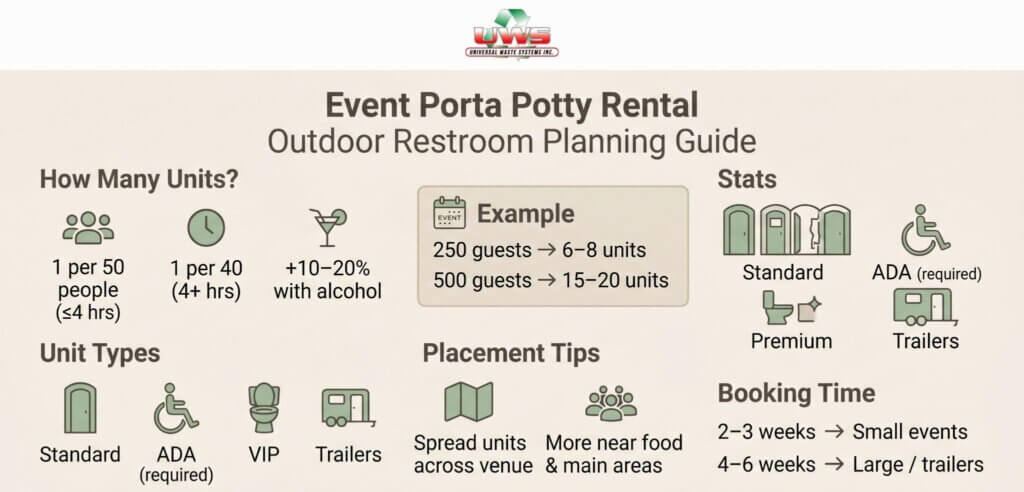
The Portable Sanitation Association International sets the industry baseline at one unit per 50 people for events up to four hours. For events running longer or serving food and alcohol, that ratio shifts. Industry practice moves toward one unit per 40 people for gatherings exceeding four hours, with an additional 10 to 20% added when alcohol is being served.
A 250-person outdoor wedding with a four-hour reception and an open bar lands in the range of 6 to 8 units by those standards. A 500-person festival running eight hours with food vendors needs closer to 15 to 20. These figures are starting points, not ceilings. Events with a high proportion of women, older attendees, or young children typically see higher per-person usage than the baseline accounts for.
Multi-day events add another layer. A standard portable toilet handles roughly 200 uses before requiring service. An event running Friday through Sunday with no mid-event servicing scheduled will have a very different experience by Saturday afternoon than one with daily pump-outs built into the agreement.
Unit Types and When Each One Applies
Not every event calls for the same unit. The crowd, the setting, and the tone of the event all factor into which units make sense.
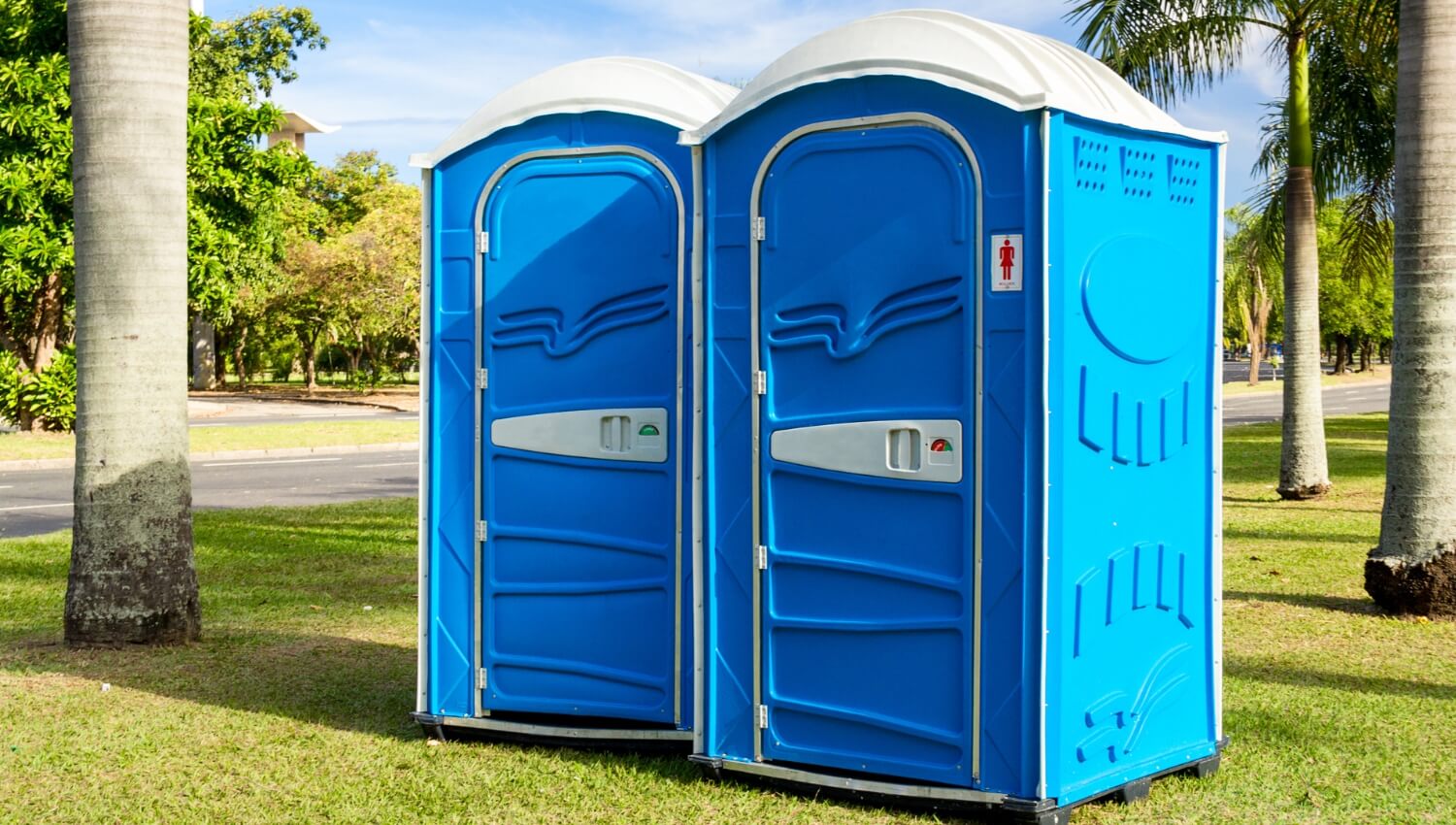
Standard portable toilets are the baseline for most outdoor events. They handle general crowd capacity and work across a wide range of event types from community festivals to sporting events.
Wheelchair-accessible ADA units are a legal requirement at any public event. The Americans with Disabilities Act requires accessible restroom facilities at public gatherings, with a general standard of at least one accessible unit for every 20 standard units on site. ADA units feature wider doorways, ground-level entry, interior grab bars, and sufficient turning space for a wheelchair.
VIP portable toilets and executive units fit ticketed areas, sponsor sections, backstage access, or any portion of an event where standard units would feel out of place. They offer interior finishing, better ventilation, and a cleaner overall experience than a standard unit without the footprint of a full trailer.
Trailer-mounted restrooms are the right call for high-attendance events where throughput, appearance, and multi-stall capacity all matter. A restroom trailer with six stalls processes significantly more people per hour than six individual units scattered across a venue. They are well suited to weddings, corporate events, and any gathering where the restroom experience reflects on the event itself.
Portable hand washing stations belong adjacent to every unit cluster, and are a requirement rather than an optional add-on at food service events.
Placement Matters as Much as Unit Count
A correct unit count placed in one corner of a large venue still produces long lines. Units placed near the main stage or primary food service area get disproportionate traffic while units elsewhere sit underused.
The general practice is to distribute units in clusters across the venue rather than concentrating them in one location. High-traffic zones like the area near the stage, food vendors, and the main entrance warrant more units per cluster. For linear events like road races or golf tournaments, units need to be spaced along the course rather than concentrated at the start and finish.
ADA units should be placed on level ground with clear, unobstructed access. A compliant unit positioned behind a curb or on uneven terrain does not function as accessible regardless of its specifications.
Booking Lead Time
For a single-day event with a straightforward unit count, two to three weeks is generally sufficient lead time. Multi-day events, events requiring trailers, or events falling during peak periods in late spring and summer warrant booking four to six weeks out. Trailers in particular have limited regional availability, and waiting until the month of the event is a reliable way to find the specific configuration you need is already committed elsewhere.
Confirming the servicing schedule at booking rather than after delivery is the other detail that separates a successful event from one that runs into problems by mid-afternoon on day two.
Why UWS for Event Porta Potty Rental
Universal Waste Systems is a family-owned company founded in 1986, with three generations of the Blackburn family managing operations across the Southwest. UWS serves Arizona, New Mexico, and Southern California with the equipment depth and regional routing to handle events across those markets reliably.
The unit mix matters as much as the unit count. A provider that carries standard units, ADA portables, VIP units, and trailers can put together the right setup for an event. One that carries only standard units cannot. Call (888) 726-0027 or request a quote online to confirm availability and build out the right unit mix for your event.
Frequently Asked Questions
How many porta potties do I need for a 200-person outdoor event?
For a four-hour event without alcohol, four units covers the PSAI baseline of one per 50 people. Add one or two more if alcohol is being served or if the event runs longer than four hours. At least one of those units should be an ADA-accessible portable.
Are ADA-accessible portable restrooms required at outdoor events?
Yes. The Americans with Disabilities Act requires accessible restroom facilities at public events. The general standard is one accessible unit for every 20 standard units on site. ADA portables must be placed on level ground with unobstructed access, not simply labeled as accessible.
What is the difference between a VIP portable toilet and a restroom trailer?
A VIP or executive portable toilet is a single standalone unit with upgraded interior finishing, better ventilation, and improved amenities over a standard unit. A restroom trailer is a multi-stall facility mounted on a trailer, with running water, interior lighting, and climate control in some configurations. Trailers process higher volumes per hour and are appropriate for events where the restroom experience is part of the overall guest experience.
How often do event porta potties need to be serviced?
A standard unit handles roughly 200 uses before requiring service. For a multi-day event, daily servicing is the standard practice. Events running a single day typically do not require mid-event pump-outs unless attendance significantly exceeds the initial estimate or the event runs longer than planned.
When should I book porta potties for an outdoor event?
Two to three weeks out is sufficient for most single-day events with standard units. Multi-day events, events requiring trailers, and bookings during peak spring and summer months should be confirmed four to six weeks in advance. Restroom trailers have limited availability and book up faster than standard units.
Do I need hand washing stations at my event?
Hand washing stations are required adjacent to portable restrooms at food service events and are standard practice at any public gathering. They should be placed in the same cluster as the portable units rather than at a separate location.