Restaurant grease trap cleaning in Phoenix is a standing compliance requirement that the city writes into its sewer code. Every food service establishment that puts fats, oils, and grease down the drain has to keep its grease trap or interceptor pumped, cleaned, and documented, or risk a citation and a backed-up kitchen. Staying ahead of the schedule is cheaper than falling behind it.
Universal Waste Systems provides scheduled and emergency grease trap and interceptor pumping for commercial kitchens across Phoenix and the surrounding area, handling the cleaning, the disposal, and the records. Request a quote online to set up a service schedule.
Why Regular Cleaning Matters
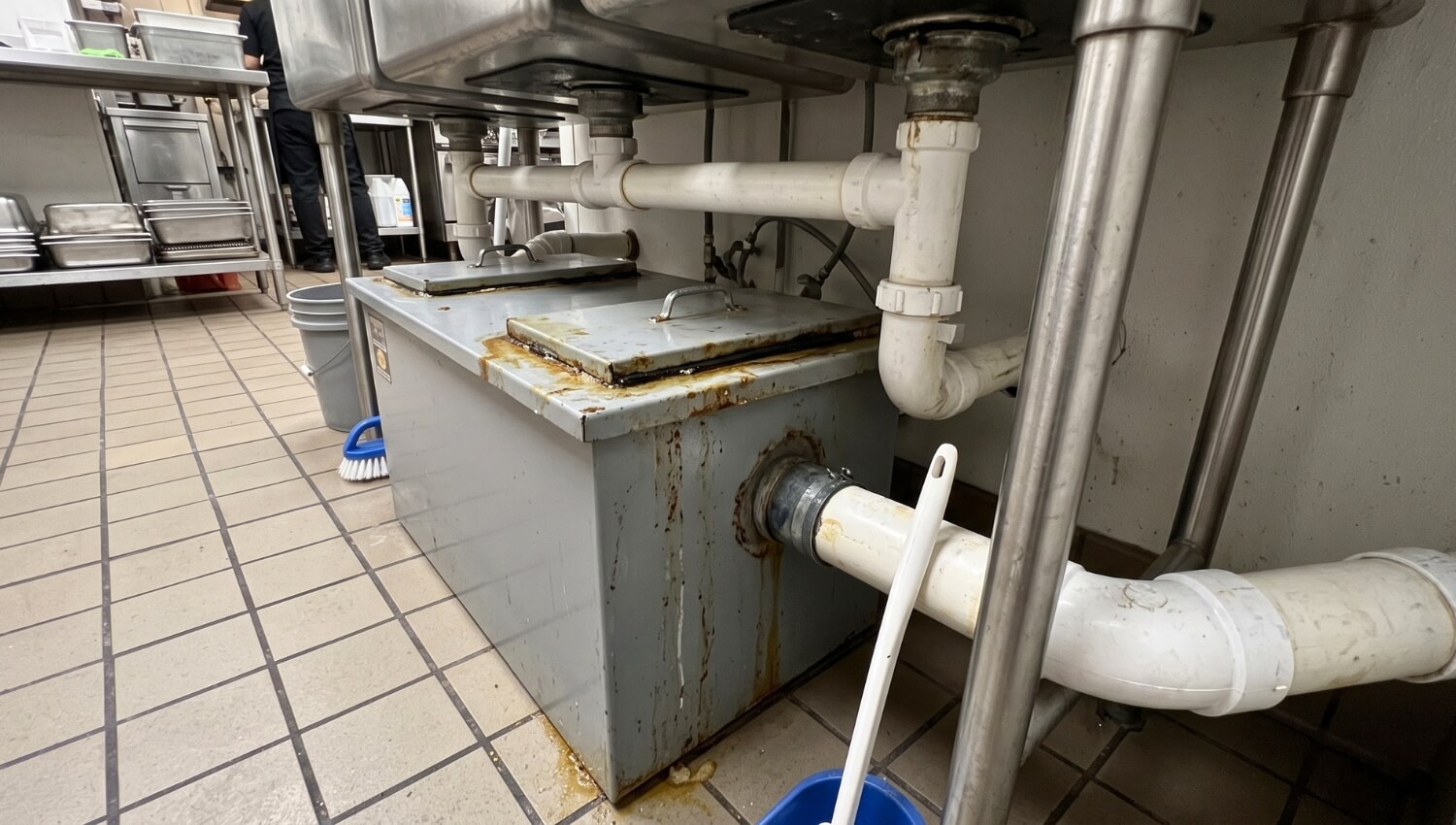
A grease trap works by slowing wastewater long enough for grease to float and solids to settle, holding both back from the sewer. That only works while there is room in the tank. Once accumulated FOG and solids fill too much of the capacity, the trap stops separating and grease starts moving downstream into the sewer line.
The consequences land on the kitchen first. A neglected trap backs up into floor drains and sinks, brings odors into the dining room, and can force a shutdown until the line clears. Downstream, grease that reaches the public sewer hardens into blockages, and Phoenix can bill a facility for the cleanup, repairs, and damages a FOG blockage causes.
Cleaning Schedules and the 25% Rule
Phoenix ties cleaning frequency to how full the trap gets. City code requires pumping before accumulated grease and solids reach 25 percent of the device’s total capacity, the threshold at which a trap loses its ability to separate FOG effectively. A trap kept under that line is okay, one that crosses it is not.
How fast a trap hits 25% depends on the schedule. A small indoor grease trap at a high-volume kitchen can need service weekly or monthly, while a large outdoor gravity interceptor may run monthly to quarterly. Phoenix sets minimum intervals on top of the 25 percent rule, with gravity interceptors at food service establishments cleaned on a regular cycle rather than left for a year.
Menu and volume set the pace. A fryer-heavy operation, a busy prep line, or a dish pit running all day loads a trap faster than a light kitchen does, so the right schedule is built around the actual FOG output rather than a generic calendar. A hauler that tracks the fill rate can tune the interval to the kitchen.
Staying Compliant in Phoenix
Grease management in Phoenix runs under Chapter 28 of the city code, enforced by the Water Services Department’s Environmental Services Division through its Commercial Inspection Program. Inspectors visit food service establishments, check the interceptor, and review maintenance records to confirm the trap is sized right and serviced on schedule.
Records come as their own requirement. The code requires a facility to keep documentation of every cleaning, the volume removed, the device capacity, and the disposal, on-site and available for at least three years. An inspector can request same-day access to both the trap and those records, so a missing manifest is its own violation.
Two rules tend to catch operators off guard. Physical pump-out is mandatory, and using enzymes, bacteria, or solvents to dissolve grease in place of cleaning is prohibited under the code. The trap also has to stay in continuously effective condition, which means repairs and correct sizing count toward compliance as much as the cleaning cadence does.
What a Grease Trap Service Visit Involves
A scheduled service means emptying the trap completely rather than skimming the top. The crew removes the entire contents, the floating grease, the settled solids, and the wastewater in between, then scrapes and cleans the interior walls and baffles so the trap starts empty. A partial skim leaves it closer to its limit and back over 25 percent sooner.
Disposal and documentation close the visit. The FOG waste is hauled to a licensed facility, and the service generates the manifest and record the city expects to see, capturing the date, the volume removed, and the disposal. Those records go straight into the file an inspector may ask for.
Timing keeps it out of service hours. Grease trap cleaning runs best before opening, after closing, or during a slow stretch, so a standing schedule with a set window keeps the work off the kitchen’s busiest hours.
Why UWS for Grease Trap Cleaning in Phoenix
Universal Waste Systems is a family-owned recycling and waste company founded in 1986, with three generations of the Blackburn family running operations across the Southwest. Our grease interceptor service covers commercial kitchens with scheduled and emergency pumping, full cleaning, licensed disposal, and the documentation compliance depends on.
For a Phoenix restaurant, that means one provider handling the cleaning cadence, the haul-away, and the records an inspector asks for, on a schedule built around the kitchen’s volume. Request a quote online to set up grease traps that keeps the operation compliant.
Frequently Asked Questions
How often does a restaurant grease trap need to be cleaned in Phoenix?
Phoenix requires cleaning before accumulated grease and solids reach 25 percent of the trap’s capacity. In practice that means a small indoor grease trap at a busy kitchen may need service weekly to monthly, while a large outdoor interceptor often runs monthly to quarterly. The exact schedule depends on the kitchen’s FOG output and the device’s size.
What records do I need to keep for grease trap compliance?
Phoenix City Code requires a facility to keep documentation of every cleaning, the volume removed, the device capacity, and the disposal for at least three years, on-site and available on request. An inspector can ask for same-day access to both the trap and the records. A service provider should supply a manifest after each pump-out for the file.
Can I use grease-dissolving additives instead of pumping?
No. Phoenix City Code prohibits using enzymes, bacteria, solvents, or similar additives to dissolve grease in place of physically cleaning the trap. Those products move FOG downstream rather than removing it, which is what the rule is designed to prevent. A full pump-out is the only compliant maintenance.
What happens if my grease trap isn’t maintained?
An unmaintained trap can trigger a notice of violation from the city’s Commercial Inspection Program, along with a deadline to correct the problem. If FOG from the facility blocks a public sewer line, Phoenix can bill the operator for the cleanup, repairs, and damages. A backed-up trap can also force a temporary kitchen shutdown until the line clears.
What’s the difference between a grease trap and a grease interceptor?
A grease trap is a small hydromechanical unit installed indoors, used in Phoenix for food service establishments with up to four plumbing fixtures. A grease interceptor is a larger outdoor, in-ground tank sized for higher-volume kitchens. Both capture FOG before it reaches the sewer, and both must be cleaned to stay under the 25 percent threshold.